


Why Two-Way Radios Lose Coverage Around Quarry Highwalls & Pits
Most quarry managers treat radio coverage like it's just about having equipment on-site. Devices charged, channels set. But signal strength doesn't care about your checklist — and if you don't understand the terrain, you're risking more than static. Highwalls and pits don't just complicate excavation. They kill line-of-sight, bounce signals unpredictably, and swallow transmission strength whole.
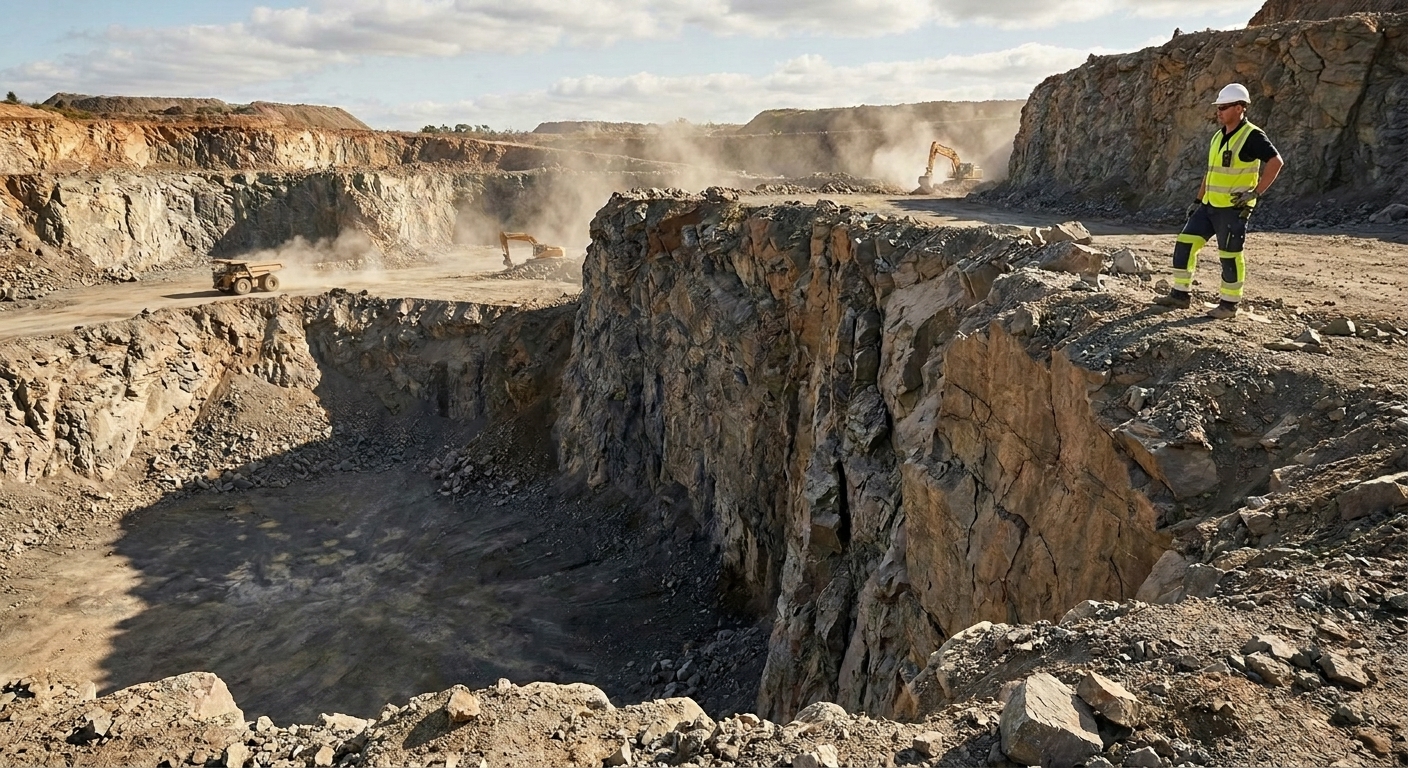
So here's what matters. If you're running operations where crews move between elevations, walls, and deep cuts, those radios better be spec'd for reality. Every dead zone should be mapped. Every repeater placement needs justification. And every communication breakdown should be traced back to terrain — not blamed on cheap hardware alone.
Rock Doesn't Let Radio Waves Through
Radio signals travel in straight lines. They don't bend around corners or tunnel through solid mass. When a highwall stands between two users, that dense geological barrier absorbs or deflects most of the transmission before it ever reaches the other side. UHF and VHF frequencies handle obstacles differently, but neither one punches through thick stone like it's air.
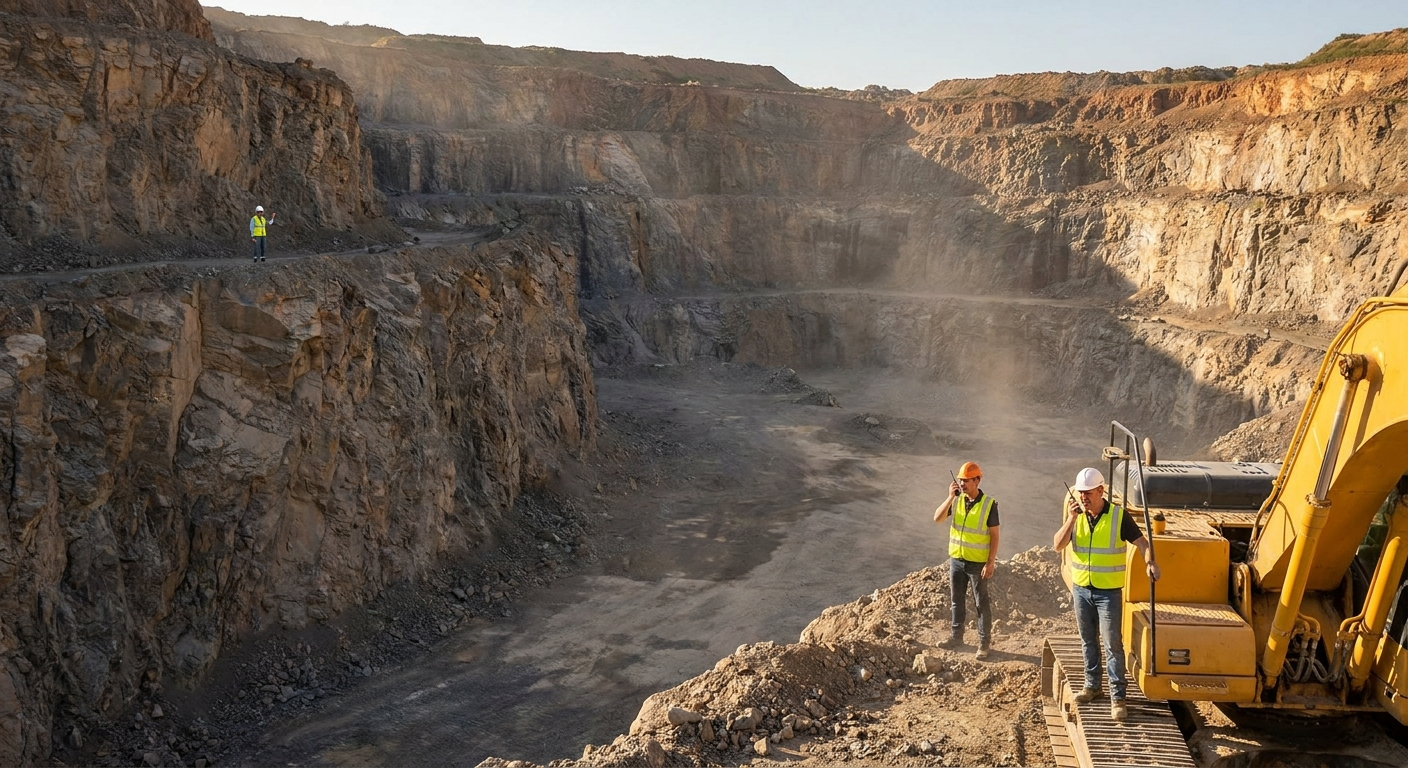
If one operator's at pit level and another's topside behind a wall, the signal has nowhere to go. It either bounces off or fades out. You might get fragments of audio or total silence. Either way, the conversation stops. And in a quarry where timing and safety depend on instant contact, that's not acceptable.
Signals Bounce and Collide
Highwalls don't just block transmissions — they reflect them. When radio waves hit uneven surfaces, they scatter in multiple directions. Some reach the receiver directly. Others take a longer route, bouncing off pit walls or equipment before arriving a fraction of a second later. That's multipath interference, and it turns clear audio into garbled noise.
The more irregular the terrain, the worse it gets. Quarries are full of jagged faces, stacked benches, and angled cuts. Each one creates another reflection point. Signals overlap, cancel each other out, or arrive distorted. What sounds fine in an open yard becomes unusable inside a working pit.
Elevation Changes Cut You Off Fast
Line-of-sight isn't optional — it's the baseline for two-way radio performance. Drop a crew into a deep excavation or position them behind a rim wall, and that line disappears. The deeper the cut or the taller the highwall, the harder it is to maintain contact without infrastructure support.
Quarries shift constantly. New benches get cut. Walls get blasted back. What worked last month might not work today. If your communication plan doesn't adapt with the layout, coverage gaps will show up exactly when you can't afford them.
Frequency Matters More Than You Think
VHF travels farther in open space but struggles with obstacles. UHF handles interference better and works well around buildings or dense terrain, but has a shorter reach. Most quarries default to UHF for exactly that reason — shorter range, better penetration through dust and minor obstructions.
But even UHF has limits. It won't push through a 40-meter highwall. It won't magically restore contact when there's no sight line. Picking the right frequency band helps, but it's not a fix for bad placement or missing repeaters. You still need to engineer around the environment.
Weather and Dust Add Another Layer
Atmospheric conditions don't help. Heavy rain, fog, or airborne dust can attenuate signals further, especially at higher frequencies. In a quarry where blasting and hauling kick up constant particulate clouds, that's a daily reality. The effect isn't as severe as a physical barrier, but it compounds existing issues.
When you're already dealing with marginal coverage, even a 10-15% drop in signal strength can push communication from unreliable to nonexistent. That's why relying on handheld units alone — without repeaters or elevated antennas — leaves too much to chance.
What Actually Fixes the Problem
You can't flatten a quarry to improve coverage. But you can design around it. Repeaters positioned on high ground extend range and bridge dead zones. Higher-wattage radios push signals farther and punch through interference better. Quality antennas make a measurable difference, especially when mounted properly.
Here's what works in the field:
- Repeater systems installed at elevated points to relay signals across pits and walls
- Higher-output radios that can handle rugged terrain and longer distances
- Antenna upgrades matched to frequency band and site layout
- Regular site surveys as excavation progresses to adjust coverage strategy
- Backup communication protocols for known dead zones
Weak Gear Doesn't Stand a Chance
Not every radio is built for quarry conditions. Consumer-grade handhelds with low power output and cheap antennas won't survive the environment, let alone maintain coverage. Battery life matters. Durability matters. Transmission strength matters most.
If your radios are underspec'd, you'll blame the pit walls. But half the problem is running equipment that wasn't designed for heavy interference, elevation changes, and constant physical abuse. Invest in commercial-grade units or accept the gaps.
Dead Zones You Can't Ignore
Even with the best setup, some spots will drop coverage. That's reality. The key is knowing where they are, marking them, and training crews to recognize when they've entered one. Relying on radios alone in a high-risk zone is dangerous.
Here's how to manage it:
- Map coverage regularly and share updates with all site personnel
- Establish visual signals or backup comms for critical zones
- Position spotters or supervisors where they can maintain contact with isolated crews
- Use mobile repeaters on vehicles when working in shifting excavation areas
- Test radios at the start of every shift in the areas where crews will operate
Documentation Keeps Everyone Accountable
If a crew reports coverage loss, log it. Track where it happened, what frequency was in use, and what equipment failed. Over time, patterns emerge. You'll see which areas are chronic dead zones and which issues stem from hardware or user error.
That data drives smarter decisions. It tells you where to add repeaters, upgrade radios, or change protocols. Without it, you're guessing. And in a quarry, guessing leads to gaps that put people at risk.
When to Bring In a Communications Specialist
If your site is large, layered, or constantly evolving, DIY radio setup won't cut it. A professional can survey the terrain, model signal propagation, and design a system that actually works. They'll spec the right equipment, position repeaters correctly, and account for future excavation.
Here's what a specialist handles:
- Site-specific frequency analysis to minimize interference
- Repeater placement optimized for coverage and redundancy
- Hardware recommendations based on terrain and operational needs
- Ongoing adjustments as quarry layout changes
- Compliance with FCC or regional licensing requirements
Your Safety Plan Is Only as Strong as Your Signal
Radio coverage isn't a convenience. It's a safety requirement. When an emergency happens at pit level or behind a highwall, seconds matter. If your team can't reach dispatch, medical response, or supervisors, the outcome changes fast.
Highwalls and pits will always challenge radio performance. But treating coverage as an afterthought — or assuming basic handhelds will do the job — is how operations get caught off guard. Build infrastructure that matches the terrain. Test it regularly. And don't assume yesterday's setup still works today.
Coverage Gaps Are Predictable
Radios fail in quarries for reasons that can be identified, measured, and addressed. Physical barriers block signals. Reflections cause interference. Elevation kills line-of-sight. Weather and dust add friction. Weak equipment can't compensate.
The solution isn't hoping for better luck. It's engineering around the environment with repeaters, higher-output radios, quality antennas, and regular site assessments. Understanding key differences between Kenwood and Motorola radios can help operations select equipment that performs reliably in challenging environments. Quarries don't make communication easy. But the tools and strategies exist to keep crews connected — even when the terrain fights back. For operators looking to upgrade their communications infrastructure, contact our team for a site-specific consultation.
Let’s Build Reliable Communication Together
We know how critical dependable radio coverage is for quarry operations—your team’s safety and productivity depend on it. If you’re ready to eliminate dead zones and want a system engineered for your site’s unique challenges, let’s talk. Call us at 800-523-1579 or contact us today and let’s make sure your crews stay connected, no matter where the work takes them.
‹ Back
Recent Posts
-
Why Two-Way Radios Lose Coverage Around Quarry Highwalls & Pits
October 27, 2026
-
Best Two-Way Radio Systems for Rock Quarries & Aggregate Operations
October 13, 2026
-
Two-Way Radios vs. Cell Phones - Which Is Better for Farm Communication?
September 29, 2026
-
Can One Two-Way Radio System Cover Multiple Farms & Fields?
September 15, 2026
-

Do Farms Need an FCC License for Two-Way Radios?
September 1, 2026